open source
transparent
decentralized
efficient
The token can be used to obtain a variety of advertising and attention-based services on the Brave platform. The utility of the token is based on user attention, which simply means a person’s focused mental engagement.
Digital advertising is overrun by middlemen, trackers and fraud.
-
Up to 50% of the average user’s mobile data is for ads and trackers, costing as much as $23 a month.
-
Ads use about 5 seconds of mobile load time on average.
-
Ads decrease phone battery life by as much as 21%.
-
Privacy is violated when large media sites host up to 70 trackers.
-
Malware (malvertisements, ransom-ware) is up 132% in one year.
- Google and Facebook take 73% of all ad dollars and 99% of all growth.
- Revenue is recently down 66%.
- Bots inflicted $7.2 billion in fraud last year.
- Over 600 million phones and desktops run ad-blocking.
- Publishers cannot seamlessly monetize value added services.
- Advertisers lack good information on what they are paying for.
- Marketers are often fooled by bogus websites and bots that commit fraud.
- Targeting is poor, making users more likely to ignore ads.
Introducing a decentralized, transparent digital ad exchange based on Ethereum Blockchain.
Stage 1: Brave Browser
Brave is a fast, open source, privacy-focused browser that blocks malvertisements, trackers, and contains a ledger system that anonymously captures user attention to accurately reward publishers.
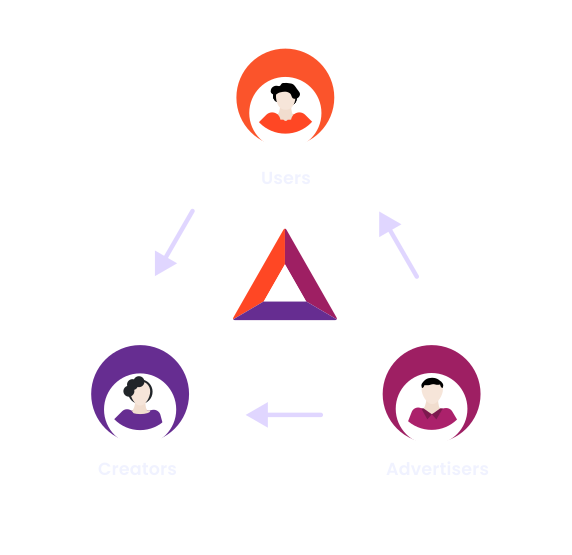
The Basic Attention Token can be used to obtain a variety of advertising and attention-based services on the Brave platform, as it is exchanged between publishers, advertisers, and users.
The token’s utility is derived from — or denominated by — user attention.
Attention is really just focused mental engagement — on an advertisement, in this case.
Stages 1 + 2 = A New Deal
The Brave browser knows where users spend their time, making it the perfect tool to calculate and reward publishers with BATs. This service creates a transparent and efficient Blockchain-based digital advertising market. Publishers receive more revenue because middlemen and fraud are reduced. Users, who opt in, receive fewer but better targeted ads that are less prone to malware. And advertisers get better data on their spending.
Measuring Attention
Attention is measured as users view ads and content in the browser’s active tab in real time. The Attention Value for the ad will be calculated based on incremental duration and pixels in view in proportion to relevant content, prior to any direct engagement with the ad. We will define further anonymous cost-per-action models as the system develops.
Ads are then anonymously matched with customer interests using local machine learning algorithms. This means less irrelevant ads.
Who Gets What?
Users viewing ads will be rewarded with BATs. BATs can be used for premium content or services on the Brave platform.
Publishers will, as part of this service, receive the lion’s share of the total ad revenue. We anticipate that users will also donate back some tokens to publishers, further increasing their revenue.
We plan to mitigate possible ad fraud through the use of cryptography, better client-side integrity, and transparency achieved through open source.
Parts of the Solution are Code Complete
Much of the infrastructure required to deploy BAT at the back end is “code complete,” meaning it’s currently in place and being used to distribute donations to publishers based on customer attention. Use it today in the Brave Browser for Windows, Mac OS and Linux.
The Basic Attention Token is the new token for the digital advertising industry. It pays publishers for their content and users for their attention, while providing advertisers with more in return for their ads.
Basic Attention Token
Press?
press@basicattentiontoken.org
Questions?
info@basicattentiontoken.org
Terms of Service
Contributors / Publishers
Privacy Policy
View Policy
Jobs? We are hiring!
View BAT Team Jobs